Wednesday, December 11, 2013

Reflecting on Studies in Mark Twain

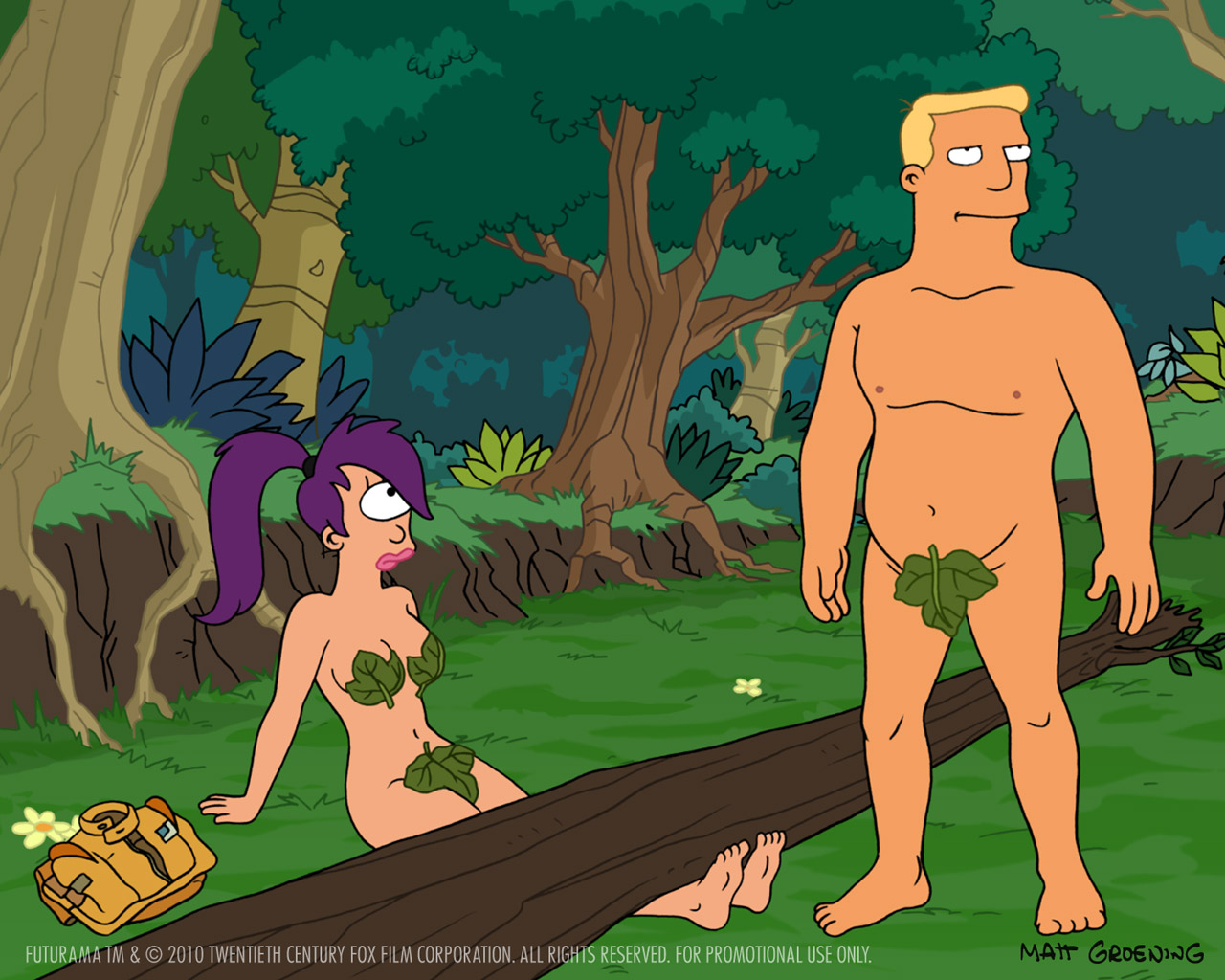
Close enough.
    The semester has come to an end and in lieu of a discussion of the last work we read for the class (in which Adam is kind of an ass who regards Eve and the rest of Gods creations for a cold scientific perspective, which is a comment on the dangers of looking at the world through a purely scientific perspective) I’d like to reflect on the class as a whole as this class was my first experience with a significant portion of Twain’s works. Now, don’t get me wrong, I’ve read the works of Samuel Clemens before. I read Huck Finn in a previous class and I saw a horrid film adaptation of the Mysterious Stranger back in high school. However, the breadth of Mark Twain’s works is a fact of which I was unaware. I now believe Earnest Hemingway’s assertion that American literature starts with The Adventures of Huckleberry Finn is disingenuous at best.

Friday, November 15, 2013

Mark Twain's Contemplation's on Murder

A Preface
            This one will not be as light-hearted as usual because the horrible things that people do to one another is a subject of which I am morbidly fascinated and completely repulsed. Please expect more questions and frustrations than usual, from me, in regards to this topic.
 
A difficult discussion is coming.
            I have written about Mark Twain’s travel writings before on this blog, and, in that previous look at Twain the traveler, he was staring at the Sphinx while experiencing a sublime moment as he pondered the ages observed by the behemoth. This post will look at his travels in the Pacific. More specifically, I’ll focus on an anecdote he told within the chapter on the Pacific in the book Mark Twain on Travel.

Friday, October 18, 2013

Would I Teach Huckleberry Finn in a Public School Classroom?

         This is the question that my professor asked on the last day of our class study of the Adventures of Huckleberry Finn. This novel has been challenged, contested, and ever rewritten once because of a certain racial slur that appears in the novel. I won’t get into why its there or the importance of its presence in the novel because so many academics (there are Mark Twain theorists who have spent their entire CV studying Twain’s novels) have argued that point up one side of the social commentary and down the other, and I have no desire to add a note to the white noise. Instead I’ll just say its there for a reason and changing it ruins the entire point. Anyway this racial slur and the delicate issue of race are the entire point that this book, the American novel as I said previously, faces plenty of contention when people who understand its significance attempt to bring it into a high school classroom.
            Now, when the question was first posed to the class, my first response was that I would teach it because my usual approach when dealing with many delicate issues is to come equipped with a brick. Apparently there are several specimens of teenage stupidity that use the novel’s context as an excuse to take advantage of the slur and ruin this important work of literature for everyone. In my smash-it-with-a-brick approach my expectation is that I’d be teaching a group of high school students who should be capable of getting over themselves for a 50 minute class.
            Do you see the problem with my logic?

Huck Finn's Observational Dilemma

            Adventures of Huckleberry Finn was published in 1884 and has been hailed as the great American novel. Since its publication Huck Finn has been studied endlessly since then on its societal implications. One of the subjects of analysis in the novel is Huck’s perception of reality. As I said in a previous post, Huck questions the stories and practices he hears and sees. He finds logical inadequacies and picks at them with a thoughtful mind. However, one problem complicates this. Huck can notice and question problems but he has trouble forming conclusions due to his lack of experience and learning. The way I phrased it to some classmates is that Huckleberry Finn is intelligent but ignorant.
            His mindset is displayed quite well throughout the novel but one section struck me in particular. Toward the beginning of the novel he is listening to Miss Watson, the sister of the woman who is taking care of him, teach him about religion. I’m not going to call it Christianity because it is my belief that the past several centuries of Christians, especially in the early United States, entirely missed the point of the Bible and Christianity as a whole. I’ll not go any further with that because I’ll never stop writing if I get going with my many problems with the ‘Murican take on Christianity.

Friday, October 11, 2013

Tom Sawyer’s Reality

            The Adventures of Tom Sawyer is a novel that captures the imagination of children and succeeds in its depiction of the young Tom Sawyer. In addition to talking neighborhood children into believing that painting a fence is the most fun a kid could have on a weekend, he also went on many adventures with his new friend Huckleberry Finn. Tom’s vivid imagination flavors these adventures as relying on stories is how Tom contextualizes his world.

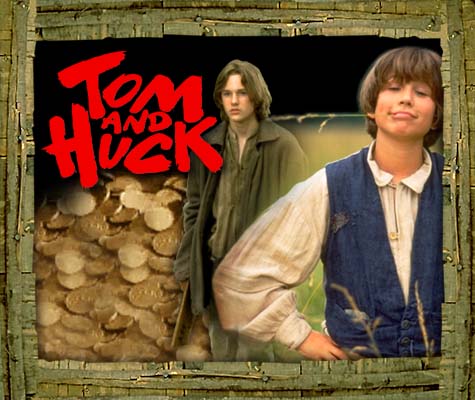
For those of you who wished to forget that this movie happened...
Your welcome.
            For one of these adventures Tom approaches Huck Finn, after unsuccessfully trying to recruit other boys from his town, with the prospect of digging for possibly-real treasure, which Tom believes has been buried nearby by possibly-real robbers. The story’s narrator describes this desire as a natural step in the development of a young boy’s imagination. “There comes a time in every rightly constructed boy’s life when he has a raging desire to go somewhere and dig for hidden treasure” (Twain 158) After Tom makes his proposal Huck asks where they should dig for this buried treasure. To which Tom responds that they can dig almost anywhere but the treasure is “hid in mighty particular places” like on islands, under limbs of dead trees, and/or under the floorboards in haunted houses.

Tuesday, October 8, 2013

Thing Theory in Tow Sawyer

            In the year 1876 Mark Twain published The Adventures of Tom Sawyer, which is a story about a young boy’s life in a small town. The characters were based on Twain and his childhood friends and the small town serving as the setting for Tom’s adventures is based on Twain’s hometown of Hannibal. The novel does not have a traditional story structure but instead plays out in a series of episodes in Tom Sawyer’s life.
            One of the more famous episodes in Tom’s story appears early in the novel and involves Tom white washing a fence- and by that I mean Tom tricking the neighborhood children into thinking that white washing a fence is not only a fun pastime but a privilege that they should pay Tom to partake in (I know I’m not supposed to end a sentence with a preposition, so I’m ending this one with parentheses).
            But what do these children, in a fictional impoverished village based on a real impoverished village in Missouri, have for Tom as payment. They have no money, so what do they have of value? Well, things of course.

Friday, September 27, 2013

Mark Twain's Confrontation with the Sublime

So, relatively early in Mark Twain’s career he traveled around the world having various adventures in various countries and learning important lessons. For instance: German opera is fine apart from the singing, the barbers in Paris are impostors, and the Italians would give Michelangelo credit for the Leaning Tower of Piza if not for its tenuous relationship with 90 degree angles.

Twain wrote two major travel volumes: Innocents Abroad and A Tramp Abroad; the above lessons come from the latter work, which approached the world and travel writing from a different perspective from his former travel writing. The brilliance and humor of A Tramp Abroad stems from his approach as an egotistical American visiting all the longed for places in the world and not being impressed. However, his volume, Innocents Abroad took a much more contemplative look at the foreign countries he visited.

Sunday, September 15, 2013

Mark Twain's War Days

           Mark Twain fought in the Civil War—sort of. In “The Private History of the Campaign that Failed” Twain recounts his days in the war. Days in this sense is not figurative as his involvement in the war only lasted a few weeks before the militia he was part of disbanded. His experience during these few weeks was rather uneventful until something happened that gave Mark Twain his fill of war.

When the Civil War broke out Mark Twain was in Missouri, visiting the city of Hannibal in Marion County, where he spent his childhood. When the Union began to enter Missouri the Governor called for militia groups to fight back. Twain banded together with several other men of Marion County to form the Marion Rangers.

This group of soldiers wandered around the neighboring counties staying in the homes of farmers, barns, and campsites. They pack up and move on at the very rumor of approaching Union soldiers.
Twain was a lieutenant in this militia but since no one would take orders from him, his rank was rendered moot. It begs the question what’s the point of a leader without followers. Is someone still a leader if no one follows them? I wonder if Twain considered that question at the time. If he did, he didn’t have much time because his military career was cut short.

Monday, September 9, 2013

Mark Twain on Fenimore Cooper’s Offences to Literature

   When the people think of Mark Twain they think of his regionalist/realist writing style, his interesting stories with colorful characters, and voyages on the Mississippi River. I imagine, however, that his literary criticisms do not come to mind first, if at all, but literary critic is another of the many trades in which Mark Twain excelled. One, rather humorous, example of Twain’s witty criticism chops is titled “Fenimore Cooper’s Literary Offences,” in which Twain holds Cooper to task on the importance of observation, research, and accurate details to support a narrative’s believability.

Saturday, November 24, 2012

Walter Dean Myers: Author

  He is one of the most prolific authors of our time. Since the late sixties he has written 90 books, 85 of which have been published. His writing has won many awards and garnered him plenty of recognition, some good and some better. This post will take a look at the author of Monster, our class reading, Walter Dean Myers.

   Bio: He was born in West Virginia in 1937 as Walter Milton Myers and somehow ended up in the care of Herbert and Florence Dean in Harlem. To this day he has no clue as to why he was given up but he does know that his adopted parents loved him very much.

   Throughout his education he did not do very well academically but played basketball. When he was in high school one of his teachers noticed that Walter liked to write and she told him to always write no matter what happened to him.

   She said, "It's what you do."

Thursday, November 1, 2012

A World Gone Virtual

Gaming Hamster is gaming. 
  This week in we are going to talk abut Virtual Worlds, meaning a world/atmosphere that exists in a virtual space as opposed to a physical space. Now, those who know me well will likely be expecting me to talk about videogames because I study/play videogames with great frequency and the subject of Virtual World lends itself so well to a discussion of videogames. Those people will be either disappointing or surprised. I'm not going to talk about videogames today. I'm going to talk about a movie.


  The film industry has made several entries that capitalize and explore the concept of worlds that exist in a different plain of existence, ex. "Inception" or worlds that exist in a computer environment, ex. "The Matrix." Both films are great and to a great job of exploring those various worlds but they have been talked to death and I have nothing new to add to their discussions.


  In the movie I want to talk about today the Virtual World exists in the internet and it wasn't created by robots as a way to subjugate mankind or for any malevolent reason. The world was actually created to bring the planet together. The movie in question is "Summer Wars," an anime, and the Virtual World is OZ, an internet institution that merges the social network and web browsers. Here's a trailer.

Thursday, October 25, 2012

The Collective IQ of Wikis

  Today, we are going to talk about the crowdsourced informational encyclopedic website called Wikipedia. The website has sparked some controversy in academia because of its crowdsourced nature. Crowdsourcing, as defined by Merriam-Webster's website, is "the practice of obtaining needed services, ideas, or content by soliciting contributions from a large group of people and especially from the online community rather than from traditional employees or suppliers." The source of Wikipedia's information is the whole of the internet. Anyone can sign up for an account and add/change content and the very nature of this source is where the controversy comes from.

Tuesday, October 9, 2012

Young Adult Literature Recommendations: Part 1

Hi, my name is Matt and this is a recommended reading list for Young Adult Literature class. The books in this list are ones that I enjoyed during my middle school to high school years. I thoroughly enjoyed each one and I whole heartily recommend them. We'll start with the author that got me started


Michael Crichton
Crichton was a medical doctor in his professional life and he wrote many non-fiction works/stories on the subject. His fiction novels usually follow a team of scientists as they group together to solve a dire problem.

Andromeda Strain- Crichton's first novel. A an object of unknown origin crashes to Earth and unleashes an unheard of sickness on the population of a small town. A team of scientists is gathered to find out what is happening and why.

Jurassic Park- Dinosaurs. Seriously, what more do you want. The novel is quite interesting and much more engaging than the movie. A wealthy entrepreneur invites a teams of scientists to examine and give an endorsement for his dinosaur amusement park.

Lost World- Also dinosaurs. Also much better than the movie. One of the characters from the first novel goes to the island where the dinosaur testing for the amusement park was performed.


Sphere- A novel about the mind, imagination, and the mystery at the bottom of the ocean. A team of scientists have to travel to travel to the bottom of the ocean to examine a mysterious discovery. I have read this book so many times that I have had to buy three copies. One of my very favorite novels of all times.

State of Fear- Not exactly YA Lit and I only read it a few years ago but the novel is amazing. It is a fiction piece with the controversy of global warming as a backdrop.


Arguing With Form

Lorem ipsum dolor sit amet, consectetur adipiscing elit. Proin scelerisque pulvinar metus facilisis lobortis. Integer interdum varius condimentum. Fusce feugiat diam eget sem mattis hendrerit. Aenean hendrerit, libero eget scelerisque ultricies, nibh quam tempor odio, at aliquam nisl leo et diam. In condimentum rhoncus erat, ut accumsan tellus vestibulum in. In dui lacus, vehicula id consequat ac, placerat at diam. Aenean mollis imperdiet risus, ut consectetur eros pretium non. Nulla facilisi. Aliquam ultrices ornare luctus. Aliquam vitae sapien sed nulla varius convallis. Ut ipsum est, pharetra ut pretium a, pretium a turpis. Sed non euismod quam. Maecenas ut dui lectus. Curabitur sit amet mauris augue, in tempor enim. Suspendisse sollicitudin suscipit dui vitae sodales. 

Donec sollicitudin nunc nec erat varius auctor dapibus lectus tempor. Nunc ut adipiscing metus. Pellentesque dictum, mi id tincidunt lacinia, tellus purus commodo orci, nec ultrices sapien massa et mauris. Pellentesque convallis ipsum eget lorem tincidunt scelerisque. Vestibulum at massa vitae eros accumsan lobortis ornare non dui. Fusce ultricies neque eu turpis tincidunt at venenatis lacus imperdiet. Ut sagittis leo vel massa egestas nec aliquet risus imperdiet. In aliquam, magna quis varius facilisis, arcu eros auctor felis, in ullamcorper lacus elit eget nunc. Aliquam erat volutpat. Etiam quis ligula quis mi euismod ultricies. Nam at feugiat ante. 


Thursday, September 27, 2012

Gamertag: The Online Identity of a Gamer

X-Box Gamertags
  My name is Matt and this entry is for my Digital Rhetoric class. I will be talking about the concept of Online Identity as far as videogames are concerned but I am limiting the topic even further to console videogames because I am only recently getting into pc gaming. For those unaware; yes there is a difference.

  In the virtual world of videogames gamers interact online in a mode typically referred to as multiplayer and each and every gamer has their own online identity known as their gamertag which linked to their account on their console. The quantity of multiplayer games has increased exponentially since the start of the current generation of game consoles (Playstation 3, X-Box 360, and Nintendo Wii/ Wii U which will be released soon).

Tuesday, September 18, 2012

Narrative Mechanics: Strays

  At its heart "Strays" by Mark Richard is a story about stability vs chaos. The story handles themes of abuse and neglect and is a tragedy in that the downfall is caused by the fatal flaw of the main characters. In the case of "Strays" the fatal flaw is that the boys are young children and therefor powerless to affect the world around them.
  The two boys desperately try to grasp onto something consistent in their lives but because they are so young they are at the mercy/indifference of the adults around them.

  The story features a binary between Uncle Trash and the stray dogs. What makes them two sides of the same coin?

  What are the elements that provide the boys with stability?

  How does the very broad strokes first person style affect the tragedy of this narrative?

  The adults spend the story destroying the elements of stability in the boys' life. What does the work accomplish by having the boys destroy that last vestige of stability?


Thoughtful Cat is very thoughtful.

Monday, September 17, 2012

Interacting with Rhetoric in Virtual Worlds: Blog Remix


  The studies and practices of rhetoric have been around since the fifth century BCE where the Greeks used the language skills taught to them by the Sophists to operate within the structures Greek democracy. These new methods of discourse became known as rhetoric and since then it has been evolving to include new mediums and styles. 

  One new rhetorical medium that is still in its fledgling stages and has immense potential and value is video games. The medium of video games gets a lot of bad press. Some of it is deserved and some is overhyped scare mongering perpetuated by a public that would rather stick its fingers in its ears than admit that video games can be more than noisy diversions for children and violence obsessed teenagers. 

Thursday, September 13, 2012

Salutations All Around!

  Greetings. Welcome to this educational blog where we will be replacing the chalkboard. And yes I said we. That doesn't mean that I am some crazy Tyler Durden persona with multiple identities in one body. We means that I want you to get involved. My name is Matt and I will be your host.

  Now, I am a college student and I made this blog for my classes so the content here will be very analytical and critical. But I will not forget that this stuff is fun as well.

  This blog will regard my "learnings" as learning cart so eloquently stated. And the focus will be literature because I am an English Major. My definition of literature, however, is rather broad. To me literature includes the following:

  • Books
  • Movies
  • Television Shows
  • Song Lyrics
  • Comics
  • Graphic Novels (Yes there is a difference)
  • Video Games
  • And I'll likely add more to the list as I go.
  Thank you for reading and I'm looking forward to some discourse.